
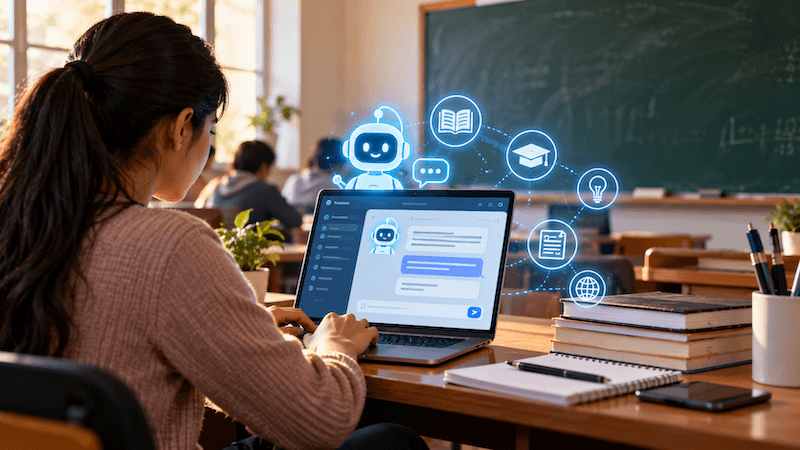
A student today can open an app, type a question, and receive an explanation in seconds. Something that once required a tutor, a classroom, or hours in a library now takes a few keystrokes.
It is tempting to read this as the end of traditional coaching.
It isn't.
Artificial intelligence is genuinely transforming how students learn, but the real question was never whether AI will replace coaching. It is what AI is actually good at, what it isn't, and how the smartest students have quietly learned to use both at once.
Give AI its due. Tools like ChatGPT are exceptional at narrow, specific tasks, explaining a concept a different way, generating practice questions, summarising dense material, answering at any hour of the night. For a student stuck on a single physics problem at midnight, this is genuinely valuable. It removes the friction of waiting for the next class or the next doubt-clearing session. Used well, AI accelerates the mechanical parts of learning: comprehension, repetition, recall.
But AI does not know a student personally. It cannot notice when a usually sharp student seems distracted for three days running, or sense that a dip in performance is about stress rather than a gap in understanding. It cannot enforce discipline, hold a student accountable to a schedule, or replicate the quiet psychological effect of studying alongside peers who are just as driven. Human mentorship offers structure, accountability and emotional support, three things that remain entirely outside what a language model can offer, no matter how advanced it becomes.
This is the distinction that gets lost in the 'AI versus coaching' debate. AI is a tool for information. Coaching, mentorship and environment are systems for transformation. Before AI, access to information was the real bottleneck. Today information is abundant, nearly free, everywhere at once. The new bottleneck is judgement, knowing which information to trust, how to structure a study plan, how to apply a concept under exam pressure. And that is precisely where experienced mentors, structured coaching and peer accountability become more valuable, not less. As AI commoditises information, human guidance becomes the differentiator between students who merely consume content and students who convert it into results.
The smartest students have already worked this out instinctively. They use AI to generate extra practice questions after a coaching session, not instead of one. They ask it to simplify a concept before returning to a mentor for deeper doubt-clearing. They lean on AI summaries to revise faster, while trusting structured test series for genuine exam readiness. AI becomes a 24-hour supplement to their environment, never a replacement for its discipline.
There is a real risk on the other side too. Students who lean on AI for every answer, rather than wrestling with a problem themselves, can build a false sense of understanding that collapses the moment real exam pressure arrives, where there is no assistant to consult. The struggle of sitting with confusion until it resolves is itself part of learning. An environment that balances AI-assisted efficiency with genuine, unaided practice will always outperform either extreme on its own.
AI is not coming for coaching. It is redefining what good coaching needs to offer, not just information, which is now freely available to anyone with a phone, but structure, mentorship and an environment engineered for genuine focus. The students who thrive in this new landscape will not be the ones who reject AI, nor the ones who surrender to it entirely, but those who treat it as one tool among many, inside a disciplined, well-supported place to learn.
There is a generational dimension to this shift worth naming honestly. Parents who grew up without any of these tools sometimes view a child's AI use with suspicion, worried it signals laziness or shortcut-seeking. Aspirants who grew up with these tools, meanwhile, often use them as instinctively as an earlier generation used a search engine, without necessarily distinguishing between using AI to understand a concept faster and using it to skip understanding altogether. Bridging that gap requires conversation, not prohibition. A parent who understands what their child is actually doing with an AI tool, clarifying a doubt versus outsourcing an entire assignment, can guide usage far more effectively than one who simply bans the technology outright and hopes discipline fills the gap on its own.
Coaching institutes themselves are adapting in ways that rarely make headlines but matter enormously in practice. Several now use AI internally to analyse student performance data at a scale no human mentor could manage alone, flagging patterns like a student consistently underperforming on a specific question type, or losing marks disproportionately under time pressure rather than from a lack of knowledge. This data then informs how a human mentor structures their next conversation with that student, turning AI into a diagnostic layer that makes human coaching sharper, not redundant. The institutes getting this balance right are not the ones racing to replace teachers with chatbots, but the ones using AI to help their teachers see each student more clearly.
Looking ahead, the more interesting question may not be whether AI replaces coaching, but how quickly coaching itself evolves to make AI fluency part of its own curriculum. Teaching a student how to prompt an AI tool effectively, how to cross-check its output against a reliable source, how to recognise when an answer sounds confident but is subtly wrong, is quickly becoming as important a study skill as note-taking or time management once were. The institutes, and the students, who treat this as a skill worth deliberately building, rather than something that happens automatically, are the ones most likely to actually benefit from everything AI has to offer, instead of quietly being undermined by it.
It is worth being honest, too, about how uneven AI's benefits currently are across India's student population. A student with a reliable smartphone, stable internet and the digital literacy to use these tools critically has access to a genuinely powerful supplement. A student without consistent connectivity, or without anyone at home able to guide responsible use, may not see the same advantage, and could in fact fall further behind peers who have both the technology and the mentorship to use it well. This is precisely why environment, coaching, guidance, a stable place to study with reliable connectivity, matters more, not less, in an AI-saturated world, rather than becoming irrelevant because information is theoretically available to everyone. Access to a tool is never the same as access to its benefits, and the gap between the two is where good mentorship earns its keep.
Looking at the arc of educational technology in India more broadly, AI is best understood as the latest chapter in a longer story rather than an isolated disruption. Television-based distance learning, then internet-enabled coaching, then smartphone apps, each wave arrived with predictions that it would upend traditional coaching entirely, and each time, the institutes that survived and thrived were the ones that absorbed the new technology as a tool rather than treating it as either a threat to resist or a replacement to surrender to. There is little reason to expect AI's story to end differently, and every reason for students to focus less on the noise around the technology and more on building the specific study habits, structured environment and mentorship access that have outlasted every previous wave of educational disruption before it.
Sources
- UNESCO, Guidance on Generative AI in Education
- Ministry of Education, Government of India (education.gov.in)