
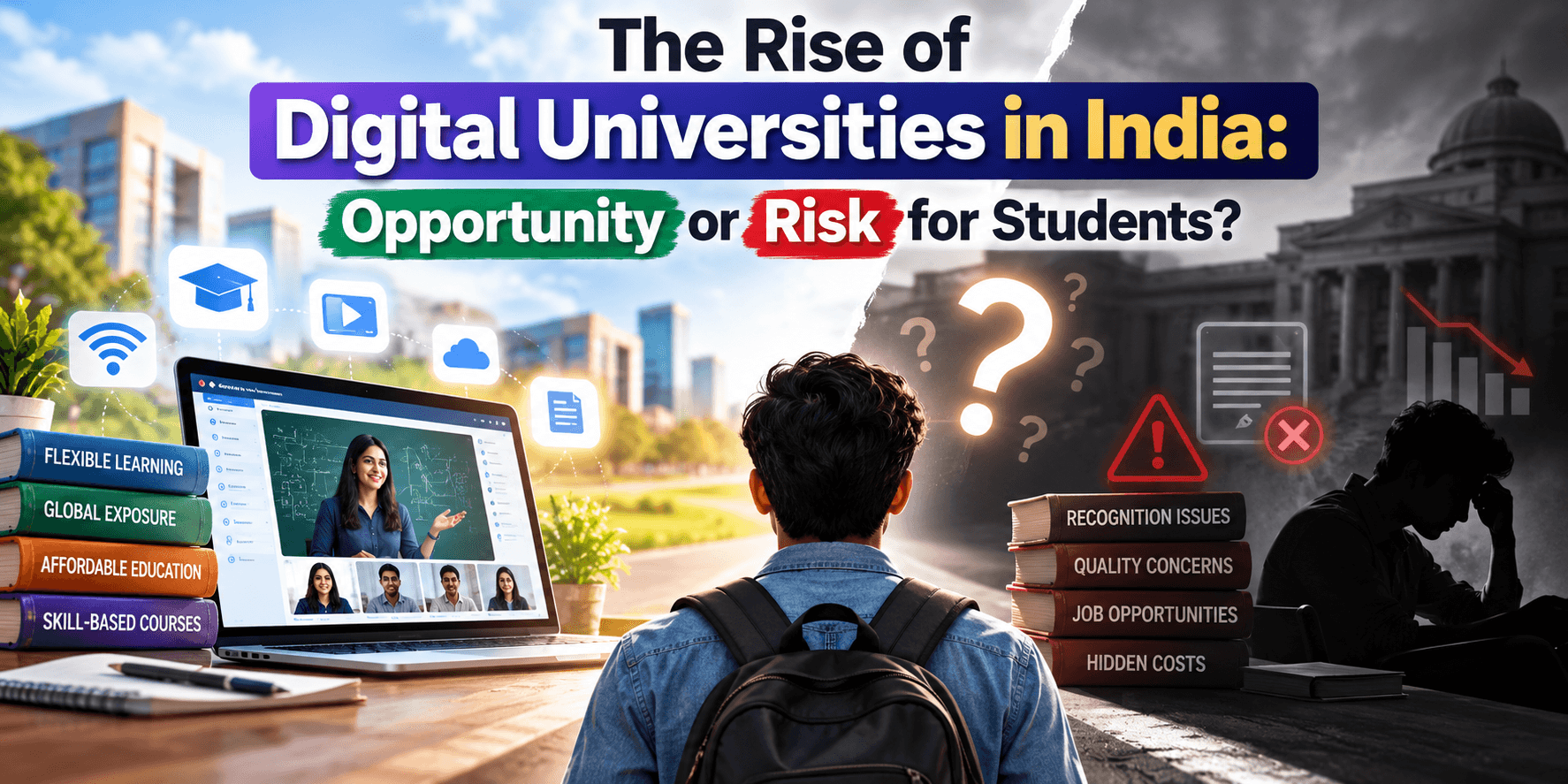
In the 2022 Union Budget, the government announced something that sounded almost inevitable: a National Digital University, built to bring together India's best institutions under one virtual roof, offering world-class education to any student, anywhere, without the barrier of a campus.
Four years later, the idea is still mostly that, an idea. The National Digital University received a modest budget allocation of a few crore rupees in 2023-24, and by 2026, insiders within the UGC itself reportedly remained unaware of any meaningful progress on the project. What was announced as a single, unifying national institution has, in the absence of that promised framework, splintered into a patchwork of state-level and institution-specific initiatives instead, each moving at its own pace, with its own rules.
This matters enormously for how students should actually think about the phrase 'digital university' today, because it does not yet refer to one clear, singular thing. Kerala built its own version years ago, upgrading an existing information technology institute into the Kerala University of Digital Sciences, Innovation and Technology under a dedicated 2021 state act, a working, functioning institution rather than a purely conceptual one. Punjab has taken a different route, announcing a Private Digital Open Universities Policy that allows private institutions to set up fully digital universities, subject to specific infrastructure requirements, a minimum of two and a half acres, digital content studios, server rooms, a learning management system operations centre, round-the-clock student support, and a minimum corpus fund in the tens of crores. Individually, these initiatives are real and growing. Collectively, they do not yet add up to the single, coherent national digital university the original 2022 announcement promised.
The broader concept these efforts are circling, sometimes described in policy discussions using a hub-and-spoke model, envisions one centralised administrative and technical unit, the hub, connected to multiple collaborating institutions, the spokes, each contributing courses and academic content under a shared digital infrastructure. Done well, this model could meaningfully expand access, letting a student in a small town access coursework from a leading institution without ever needing to relocate, and letting institutions share the cost of expensive technical infrastructure rather than each building it alone. Done poorly, without the funding and coordination the national version has so far struggled to secure, it risks becoming a fragmented landscape of unevenly regulated offerings, harder for a student to evaluate than a straightforward, single online degree from an established, UGC-recognised university.
This is precisely the gap where genuine opportunity and genuine risk sit side by side, and where a student's due diligence matters more than it ever has. The opportunity is real: access to reputable coursework without geographic or financial barriers, flexible pacing for students who are working or managing other responsibilities, and, if the broader digital university vision is eventually realised, a chance to draw on genuinely excellent faculty and content that would otherwise be locked behind a specific campus's gates. The risk is equally real: a rapidly growing, still-maturing landscape of digital and online institutions makes it easier than ever for lower-quality or outright unrecognised providers to market themselves using the same appealing language, flexible, world-class, future-ready, as the genuinely credible options. The UGC's own guidance is blunt on this point: any programme promising a complete degree through a shortcut with no verifiable institutional backing, or operating through an unauthorised franchise or third-party agent, should be treated as a serious warning sign, however polished the marketing looks.
For a student actually weighing a digital university or fully online programme against a traditional campus path, the comparison deserves to be more honest than either extreme, digital as the inevitable future or campus as the only real option, tends to allow. Online and digital formats offer undeniable flexibility and often lower total cost, particularly valuable for students balancing work, family responsibilities, or geographic constraints that make relocation genuinely impractical. What they cannot yet fully replicate is the dense, often unplanned value of physical proximity to a strong academic ecosystem, the classmate who becomes a co-founder, the professor's office-hours conversation that reshapes a career direction, the accountability of a physical library full of equally focused peers, the informal networking that, fairly or not, still opens doors in many Indian industries. For fields and career paths where this kind of dense, in-person networking genuinely drives outcomes, certain areas of finance, law, civil services preparation, elite research, the case for prioritising a strong physical education hub over a purely digital pathway remains meaningfully stronger than digital-university enthusiasm sometimes acknowledges.
None of this is an argument against digital universities as a category. It is an argument for treating the label itself with appropriate scrutiny rather than as an automatic mark of quality or, conversely, of risk. A digital university built on genuine UGC recognition, transparent infrastructure and real institutional accountability, whether it is Kerala's dedicated digital university, a properly regulated private digital institution under a state policy, or eventually the long-promised national version, can be a genuinely valuable option for the right student. A vaguely credentialed platform borrowing the same appealing vocabulary without the underlying regulatory substance is not, regardless of how convincingly it markets itself.
The practical guidance for students and families navigating this landscape today, then, comes down to three checks worth running before committing to any digital or online university option. Verify the institution's specific UGC-DEB recognition status for the exact programme and admission year in question, since recognition can be programme-specific rather than blanket across an entire institution. Weigh the specific career path against how much dense, in-person networking and physical presence actually matters within that field, rather than assuming digital flexibility is either universally superior or universally inferior to a campus experience. And treat the broader 'digital university' story as still very much in progress, a genuine, important shift in Indian higher education, but one whose most ambitious national promise remains, for now, mostly unrealised, which means today's decisions should rest on the concrete, verifiable options actually available right now, not on the version of digital higher education that policy documents describe but infrastructure has not yet caught up to.
It is worth pausing on why the National Digital University in particular has struggled to move beyond announcement, since the reasons say something useful about the gap between policy ambition and implementation in Indian higher education more broadly. Coordinating a genuinely national digital infrastructure requires sustained, substantial funding, technical capacity that many public institutions do not have in-house, and consensus among a wide range of stakeholders, existing universities, regulatory bodies, state governments, each with their own priorities and, at times, competing interests in how such a project should be structured and controlled. A single state government building its own digital university policy, as Punjab has done, involves a fraction of that coordination complexity. This helps explain why state-level and institution-specific digital initiatives have moved faster and further than the more ambitious national vision, and it is a pattern worth watching for in other large education reforms too, where the boldest, most centralised announcements sometimes progress more slowly than smaller, more contained efforts pursuing a similar underlying goal.
For students specifically drawn to digital and online formats for financial reasons, cost genuinely can be a significant advantage worth taking seriously, not dismissing as a lesser motivation. Online and digital programmes typically carry lower tuition than equivalent campus-based options, and they eliminate the often-substantial cost of relocation, accommodation and daily living in a new city, expenses that can meaningfully exceed tuition itself over a multi-year programme. For a student from a financially constrained background, a well-chosen, properly recognised digital or online programme can represent genuine access to postgraduate education that a costly relocation might otherwise have placed out of reach entirely. This economic dimension deserves to sit alongside the flexibility and networking considerations already discussed, rather than being treated as a secondary factor, because for many Indian families, it is, quite honestly, the primary one driving the decision in the first place.
It is also worth watching how India's approach compares with more mature digital higher education markets abroad, where fully online universities have operated at scale for considerably longer. In several such markets, the reputational gap between top online and top campus institutions has narrowed significantly over a decade or more, not because regulation alone forced the change, but because well-run online institutions built genuine track records of graduate outcomes that employers eventually could not ignore. India's digital university landscape is earlier in that same maturation curve, which is precisely why patience, verification and realistic expectations matter more right now than they will a decade from now, once more of these institutions have had time to build comparable track records of their own.
Frequently Asked Questions
What is a digital university in the Indian context?
It generally refers to an institution or framework offering full degree programmes through online and digital infrastructure, sometimes built on a hub-and-spoke model connecting a central administrative unit with multiple collaborating institutions.
Has India's National Digital University actually launched?
Not fully. Despite being announced in the 2022 Union Budget, it received only a modest initial allocation and has seen limited visible progress by 2026, with much of the momentum shifting to state-level and institution-specific initiatives instead.
Is Kerala's digital university a real, functioning institution?
Yes, the Kerala University of Digital Sciences, Innovation and Technology was established under a dedicated 2021 state act by upgrading an existing information technology institute, making it a genuine, operational example.
How can I verify if a digital university is legitimate?
Check the institution's specific UGC-DEB recognition for the exact programme and admission year, and be cautious of any provider promising a full degree through an unusually fast, cheap or franchise-based route.
Is a digital university degree as valuable as a traditional campus degree?
Legally, UGC-recognised digital and online degrees carry equal standing to campus degrees. Practically, value also depends on the specific career field's reliance on in-person networking and institutional reputation.
Which career paths still benefit more from a physical campus experience?
Fields that depend heavily on in-person networking and institutional access, such as certain areas of finance, law, civil services preparation and elite research, tend to still favour strong physical education hubs.
Are private companies allowed to set up digital universities in India?
Under specific state policies, such as Punjab's Private Digital Open Universities Policy, private institutions can establish digital universities, subject to defined infrastructure and regulatory requirements.
What should students prioritise when choosing between a digital and a campus-based programme?
Weigh flexibility and cost against the specific career path's reliance on physical networking, institutional reputation and hands-on components, rather than assuming either format is universally better.
Why has India's National Digital University progressed so slowly compared to state-level efforts?
Coordinating a genuinely national digital infrastructure requires far greater funding, technical capacity and stakeholder consensus than a single state-level initiative, which helps explain why smaller, more contained projects have moved faster.
Are digital university programmes generally cheaper than campus-based ones?
Yes, they typically carry lower tuition and eliminate relocation and daily living costs, making them a genuinely significant option for financially constrained students, provided the specific programme is properly UGC-recognised.
What should I check before enrolling in any online or digital university programme?
Verify UGC-DEB recognition for the specific programme and admission year, review the institution's track record and infrastructure, and avoid any provider promising an unusually fast or cheap degree through a third-party agent.
How does India's digital university landscape compare to more established markets abroad?
India's digital higher education sector is earlier in its maturation curve compared to more established international markets, where reputational gaps between online and campus institutions have narrowed considerably over a longer track record.
Sources
- Careers360, "Promised, but missing: Five years on, National Digital University reduced to a budget item, with no funds"
- University Grants Commission (ugc.gov.in)
- Kerala University of Digital Sciences, Innovation and Technology Act, 2021