
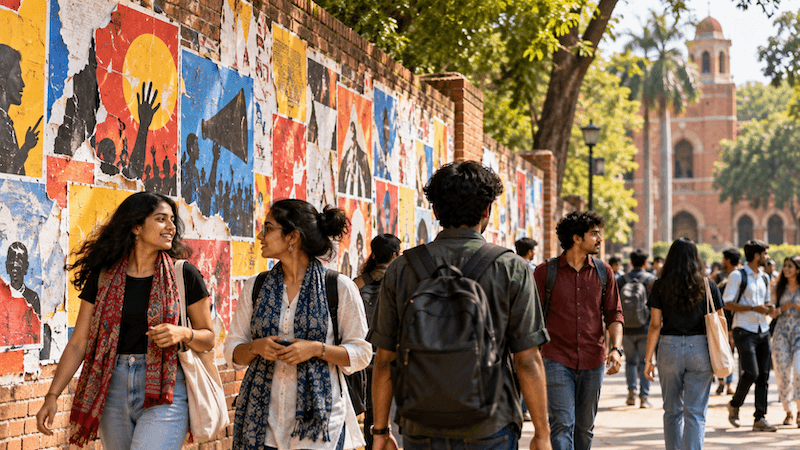
Every September, a genuinely strange ritual repeats itself across Delhi University's sprawling network of colleges. Posters go up overnight on every available wall. Candidates promise things student unions cannot actually deliver on their own. And underneath all the noise, if you actually listen closely to what students themselves are saying rather than what party workers are shouting, a fairly consistent, fairly sobering list of real, lived concerns keeps surfacing year after year.
The 2026 Delhi University Students' Union elections followed this same basic rhythm, with voting held on Friday, September 18, across colleges and departments, and results for the four central posts, President, Vice President, Secretary and Joint Secretary, declared the following day. More than 1.51 lakh students were eligible to vote, with overall turnout reported at approximately 40.46 percent, a genuinely useful, factual data point worth understanding in its own right, separate from whichever specific party or candidate any individual reader happens to favour. Twenty candidates contested the four central posts this year, alongside a considerably larger, separate set of elections for individual college level student bodies held simultaneously across the university.
The Akhil Bharatiya Vidyarthi Parishad fielded Yash Dabas for President, Eshu Maurya for Vice President, Riya Chhawadi for Secretary and Lakshyaraj Singh for Joint Secretary, while the National Students' Union of India and a joint AISA-SFI panel fielded their own competing candidates across the same four posts. Reporting this factually, as the actual outcome of a democratic student election, matters considerably more here than any specific analysis of which party's broader political strategy or messaging proved more effective this particular year, a question well outside what a genuinely neutral, student focused account like this one should attempt to adjudicate either way.
What is genuinely more useful and more durable than any single year's specific result is understanding what issues actually shaped this particular campaign season, since these tend to persist meaningfully across election cycles regardless of which specific party or candidate ultimately wins any given year. Affordable and safe student accommodation emerged as a consistently, repeatedly cited concern this year and it did so against a genuinely serious, immediate backdrop. Earlier in September 2026, a five storey paying guest accommodation building collapsed in the Satya Niketan area near Delhi University's South Campus, an area densely packed with student housing, killing seven people, including students. This tragedy brought accommodation safety into unusually sharp, urgent focus during the campaign, well beyond the more familiar, longstanding complaints about affordability and hostel seat shortages that Delhi University students have voiced in election after election for years.
Functioning, adequately maintained college hostels represented a related but genuinely distinct concern raised throughout the campaign, separate from the private, off campus paying guest and rental accommodation market that the vast majority of Delhi University students, given the university's genuinely limited on campus hostel capacity relative to its overall student population, actually depend on for their day to day housing. Affordable food and reliable transport, including specific calls for concessions on Delhi Metro fares for students, were raised as related, practical, everyday cost of living concerns that directly affect a student's actual capacity to focus properly on their studies, regardless of how strong their academic ability or personal motivation might otherwise be.
Examination related concerns also featured prominently this year, connecting quite directly to the broader national conversation around examination integrity and reform that dominated headlines through much of 2026. Delhi itself had seen a significant, sustained student led agitation in June and July, organised under the banner of the Cockroach Janta Party, specifically over the NEET paper leak and demands for broader national examination reform, and this wider national context around examination fairness and institutional accountability clearly, visibly shaped how DUSU candidates across different parties chose to frame their own specific campus level campaign platforms this particular year.
A more accessible university administration was cited as a further, broader concern, reflecting a genuinely persistent, recurring student frustration that extends considerably beyond any single specific policy issue on its own. Students across many different colleges have long described institutional bureaucracy, delayed responses to genuine grievances, and a felt sense of real distance between the university's own central administration and the actual, lived day to day student experience, as an ongoing, structural source of frustration that any specific student union administration, regardless of its particular political affiliation, genuinely struggles to fully resolve on its own during any single one year term in office.
It is worth pausing here to understand, with real clarity, exactly what a student union like DUSU can and cannot actually do about any of these specific, genuinely important issues, since this is a distinction that gets seriously blurred, sometimes quite deliberately, during election season enthusiasm and campaign rhetoric. DUSU represents students formally to the university administration, organises cultural and social events across the university, and can meaningfully advocate, sometimes very effectively and visibly, for specific policy changes on issues like fee structures, hostel allocation, and examination scheduling and conduct. What DUSU genuinely cannot do, regardless of which specific party happens to win control of it in any given year, is unilaterally build new hostels, directly regulate the private, off campus rental and paying guest housing market that the overwhelming majority of Delhi University students actually depend on day to day, or independently, single handedly reform how the National Testing Agency conducts national level examinations. These specific, structural limits genuinely matter, because student issues, in practice, actually enter university administration and government policy through a considerably more layered, indirect process than campaign promises alone often suggest, or than an eager, newly elected student politician might genuinely wish were true.
The Satya Niketan building collapse specifically illustrates this particular limitation with real, uncomfortable clarity. Student accommodation safety around Delhi University's campuses is regulated, to the genuinely limited, patchy extent it is regulated at all in practice, by municipal building codes, local fire safety regulations and individual landlord compliance, areas that sit considerably outside DUSU's own direct institutional authority or control. What a student union genuinely can meaningfully do here is advocate loudly and visibly for stronger university and municipal coordination specifically on student housing safety standards, raise sustained, sufficiently public and persistent awareness that helps meaningfully pressure the relevant municipal authorities to act with real urgency, and, in some documented past instances at Delhi University specifically, help connect directly affected students to whatever genuine emergency support and resources may actually be available in a moment of crisis. It cannot, however, directly regulate the private housing market itself, however forcefully and sincerely any specific student politician might promise to do exactly that during an energetic campaign speech.
Difference between student politics and university governance more broadly deserves one further, genuinely important clarifying distinction here too. Student politics, DUSU elections very much included, involves the genuine, legitimate contest for specific student union positions, often closely linked, whether formally or informally, to broader national political parties and their own specific student wing affiliates. University governance, meanwhile, involves the considerably larger, more complex, and admittedly less visible institutional machinery, the Vice Chancellor's office, various academic and executive councils, individual college principals and their own specific administrations, that actually makes the great majority of day to day, substantive decisions genuinely affecting student life at Delhi University. A student union can meaningfully advocate within, and to, this larger governance structure, sometimes with real, visible, tangible success on specific issues. It does not itself constitute or directly control that broader governance structure, and understanding this distinction clearly and honestly helps set realistic, honest expectations for what any specific election outcome can actually be reasonably expected to deliver in practice over the coming year, regardless of which particular candidates or which specific party ultimately won this particular cycle's four central posts.
For prospective and current Delhi University students specifically and genuinely for students at any large Indian university more broadly, the more durable, lasting and genuinely useful lesson from any given year's specific DUSU election result is not really which particular party happens to hold which particular post for that one particular year. It is the consistently recurring pattern of underlying issues these annual elections keep reliably surfacing, year after year, election cycle after election cycle: accommodation safety and genuine affordability, functioning and adequate hostel infrastructure, reliable and affordable transport, examination fairness and institutional accountability and a felt, ongoing sense of genuine administrative accessibility and basic institutional responsiveness. These are precisely the practical, everyday factors that shape a very large share of a student's actual, lived university experience, considerably more than academic rankings or institutional prestige typically ever do on their own and they are worth taking every bit as seriously by any prospective student and their family, when actually evaluating any university, as the university's own formal academic reputation and prestige so often, and sometimes exclusively, tend to receive.
It is worth noting how consistently these same underlying concerns resurface year after year regardless of which specific party ultimately wins control of the union. Hostel shortage, food affordability and transport costs have appeared in DUSU campaign coverage across multiple previous election cycles, suggesting these are structural, persistent features of Delhi University's own student experience rather than issues any single winning panel can realistically resolve within a single one year term in office. This persistence is itself informative for prospective students weighing where to study, since it signals which specific challenges are likely to remain present regardless of the particular student union administration in place during any given academic year.
For families evaluating Delhi University specifically, the practical takeaway is to treat these recurring campaign issues as a genuine, useful signal of what daily student life there actually involves, alongside the university's own considerable, well established academic reputation.
Frequently Asked Questions
How do DUSU elections actually work?
Students vote for four central posts, President, Vice President, Secretary and Joint Secretary, alongside separate elections for individual college level student bodies, with results typically announced the day after voting concludes.
What was voter turnout for the 2026 DUSU elections?
More than 1.51 lakh students were eligible to vote, with reported overall turnout of approximately 40.46 percent.
What were the major issues in the 2026 DUSU election campaign?
Affordable and safe student accommodation, functioning college hostels, affordable food and transport including metro fare concessions, examination fairness, and a more accessible university administration were key issues raised during the campaign.
Why did student accommodation safety become such a prominent issue this year?
A five storey paying guest building collapse in the Satya Niketan area near Delhi University's South Campus killed seven people, including students, earlier in September 2026, sharply focusing attention on accommodation safety during the campaign.
Can DUSU directly regulate private student housing near Delhi University?
No, private off-campus housing is regulated by municipal building codes, fire safety regulations and landlord compliance, areas outside DUSU's direct institutional authority, though the union can advocate for stronger coordination and safety standards.
What is the difference between student politics and university governance?
Student politics involves elected union positions like DUSU, while university governance involves the larger institutional machinery, including the Vice Chancellor's office and academic councils, that makes most substantive day-to-day decisions affecting student life.
Did the NEET protests influence the DUSU election campaign?
Yes, the sustained CJP-led student agitation over the NEET paper leak earlier in 2026 shaped how candidates across parties framed examination-related concerns during their DUSU campaigns.
What can a DUSU administration actually achieve for students?
It can formally represent students to the university administration, advocate for policy changes on fees, hostels and examinations, and organise events, though it cannot unilaterally build hostels or regulate private housing markets.
Sources
- India TV News, "DUSU Election Results 2026 LIVE"
- India.com, "DUSU Election Result 2026: ABVP's Yash Dabas, NSUI's Vijay Shankar Meena or AISA-SFI's Ananya Raturi"
- ANI, "DUSU election results 2026: Counting of votes begins"