
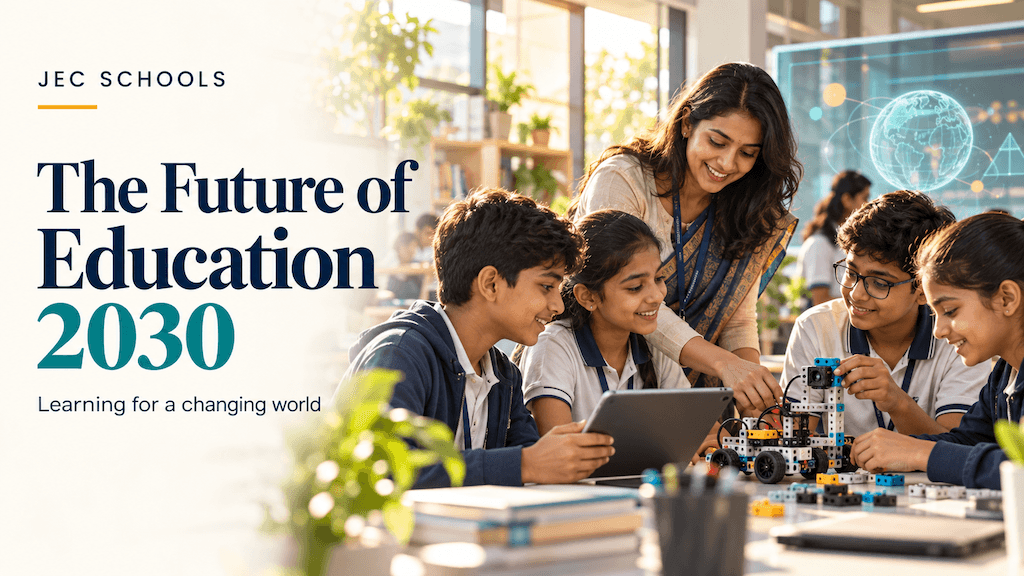
Every generation believes it is entering a stable system.
No generation actually is.
Indian education between now and 2030 is set to change more than it has in the previous two decades combined, driven by policy reform, artificial intelligence, shifting global career demands and evolving assessment models. Students who understand these shifts early will navigate them with confidence. Those who don't will simply be caught reacting, always one step behind a system that has already moved on.
As NEP 2020 implementation deepens, expect assessment across schools, and increasingly competitive exams, to test application and reasoning over memorisation. Students who lean purely on rote recall will find themselves at a growing disadvantage. Preparing for this means building genuine conceptual understanding early, rather than last-minute memorisation, a shift that rewards students who start young but is achievable at any stage, with the right guidance behind it.
Just as computer literacy became a baseline expectation in the 2000s, fluency in using AI tools responsibly and effectively is fast becoming a similar baseline skill, not a specialised one reserved for engineers. This doesn't mean every student needs to code. It means understanding how to use AI for research, learning and productivity, while building the judgement to verify and apply information correctly, will soon be expected across nearly every academic and professional path, not just the technical ones.
NEP 2020's push toward vocational exposure from an early age signals a longer shift too: skill-based and vocational education gaining genuine social and economic parity with traditional academic degrees, a change already visible in several developed economies. Students and parents who currently view vocational pathways as a fallback option may need to rethink that framing as industry demand for skilled, practically trained talent keeps growing.
Higher education itself is loosening up. Multiple entry and exit options, credit transfer systems and increasingly modular degree structures mean the traditional, rigid four-year linear degree is gradually giving way to more flexible academic journeys. This helps students who need to pause studies for financial, personal or career reasons, but it also demands more proactive planning, because flexibility comes bundled with more choices to navigate, not fewer.
And after 2026's examination integrity controversies and the legal reforms that followed, expect continued tightening of exam-day protocols, greater digitisation of testing infrastructure, and stronger institutional accountability across major examination bodies. Students should expect increasingly rigorous verification processes and should stay closely updated on evolving formats and requirements, rather than assuming procedures will stay the same from one year to the next.
None of this needs to feel like anxiety-inducing news. Treat these shifts as a planning opportunity instead. The Indian education system of 2030 will look meaningfully different from the one students are entering today, and the ones who understand that now, who build their preparation around genuine understanding, adaptability and informed guidance, will be the ones moving through this transition with real confidence, rather than catching up after the fact.
It is worth pausing on how these five shifts reinforce one another rather than unfolding as separate, isolated trends. A student building genuine conceptual understanding rather than rote memorisation is also better positioned to use AI tools well, because they can actually judge whether an AI-generated explanation makes sense rather than accepting it uncritically. A student comfortable moving between vocational exposure and traditional academics is naturally better suited to a modular, flexible higher education system that no longer insists on one rigid path chosen at seventeen and followed without deviation. And a system with tighter, more digitised examination security ultimately protects the credibility of every other reform, because none of these changes matter if the exams measuring them cannot be trusted.
For younger students, this convergence argues for starting early, not by cramming more content into an already full schedule, but by building the underlying habits, curiosity, comfort with technology, willingness to explore across subjects, that will compound in value as the system continues to shift around them. For older students already deep into a specific exam cycle, the more urgent task is simply staying informed, following official channels for policy updates rather than assuming next year's exam will look exactly like last year's, and treating flexibility itself as a skill worth practising, since the ability to adapt smoothly to a changing format may soon matter almost as much as mastery of the syllabus itself.
Families weighing school choices, career pathways or relocation decisions for competitive exam preparation over this timeframe would do well to seek guidance that is actively tracking these shifts, rather than relying on advice calibrated to a system that existed five or ten years ago. The direction of travel is reasonably clear even if the exact pace remains uncertain, and planning with that direction in mind, rather than against it, is the surest way to turn a decade of change into an advantage rather than a disruption.
It is worth adding a note of realistic caution alongside all of this optimism. Policy direction and ground-level implementation rarely move at the same speed in a country as large and administratively layered as India, and students should expect meaningful variation in how quickly these five shifts actually reach their specific school, city or exam category. A student in a well-resourced urban centre may see competency-based assessment and digital infrastructure arrive years before a student in a smaller town, even under the same national policy framework. Understanding this unevenness matters, not as a reason for pessimism, but as a reason to stay locally informed rather than assuming national headlines translate immediately and uniformly into local classroom reality. The families who navigate this best tend to combine broad awareness of where the system is heading with specific, current knowledge of how fast their own corner of it is actually moving.
Ultimately, the students best positioned for 2030 will not be the ones who predicted every specific change correctly, an impossible task given how unevenly policy translates into ground reality, but the ones who built genuine adaptability as a habit long before it was demanded of them. That adaptability shows up in small, ordinary choices made now: choosing to understand a concept rather than memorise it, treating a new technology as worth learning rather than fearing, staying curious about a subject outside one's chosen stream. None of these choices require waiting for 2030 to arrive. They are available to any student willing to make them today, which is ultimately the most reliable form of future-proofing any education system, however it continues to evolve, can actually offer.
In the end, the future of Indian education will not be decided solely in policy documents or ministry press releases. It will be decided, in small part, by every student who chooses to engage with these changes thoughtfully rather than anxiously, treating the next few years not as a system to be survived, but as one worth understanding, shaping and, eventually, improving further for whoever comes next.
That, more than any single policy or technology, is the change most worth preparing for.
Students who internalise that lesson now, well before 2030 actually arrives, will find themselves not just surviving the coming changes but genuinely benefiting from nearly every one of them.
Sources
- Ministry of Education, Government of India, National Education Policy 2020 (education.gov.in)
- UNESCO, Guidance on Generative AI in Education