
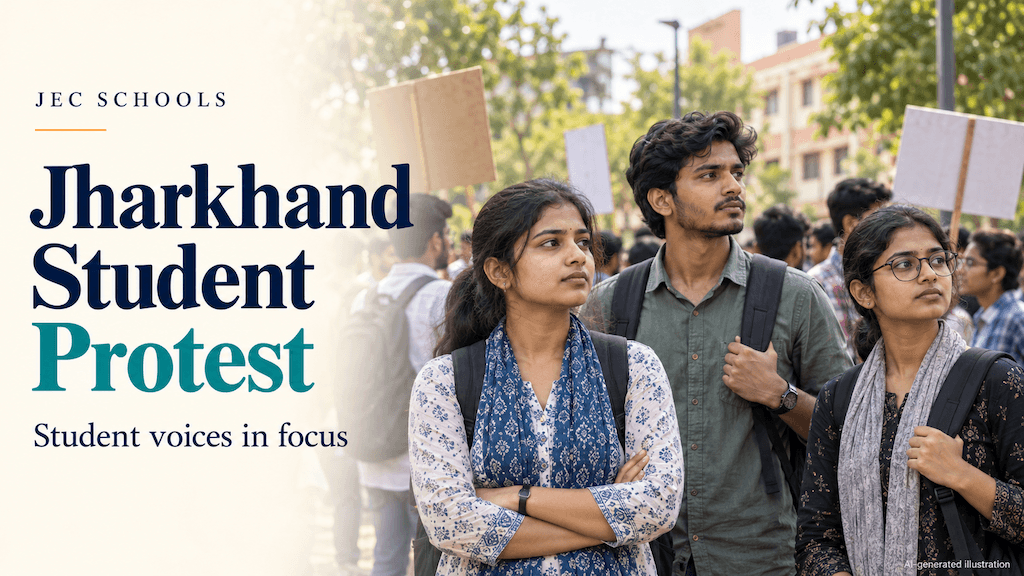
A viral answer sheet. That is what started it. Somewhere in Jharkhand a photograph of an exam answer key began circulating before the exam had even properly ended and within days hundreds of students were sitting outside a stadium in Ranchi refusing to move.
By early August 2026 that sit-in had grown into a full state-wide movement. Students camped at Jaipal Singh Munda Stadium day after day. A student leader launched an indefinite hunger strike. Police made arrests. Chief Minister Hemant Soren faced open calls for his resignation. And the demands kept expanding, from one specific exam to something much larger, a complete reckoning with how Jharkhand runs its recruitment tests.
The immediate trigger was the 14th JPSC Civil Services Preliminary Examination, conducted by the Jharkhand Public Service Commission. Allegations of irregularities in that exam, along with similar complaints tied to the Jharkhand Staff Selection Commission's CGL recruitment drive, brought students onto the streets demanding the exam be cancelled outright. The Jharkhand CID arrested the candidate at the centre of the leak allegations, a man named Suman Saurav, along with ten others described as masterminds behind the operation. It was not enough to end the protest. For the students camped out in Ranchi, one arrest did not answer the deeper question they were actually asking.
That deeper question is worth sitting with. Students protesting in Ranchi kept repeating the same point to reporters. This was not their first protest. Jharkhand has been dealing with recruitment exam controversies since it was carved out of Bihar in 2000, paper leaks, cancelled tests, results delayed for months on end. What made 2026 different was not the scale of the alleged fraud. It was the students' confidence that something could finally be done about it.
That confidence has a direct source and it is worth naming clearly. Earlier in 2026 the Cockroach Janta Party led a sustained protest movement in Delhi over the NEET UG paper leak, a movement that eventually forced the resignation of the Union Education Minister. Jharkhand's protesters said as much themselves. One core committee member, Vinay Mehta, who has spent five years preparing for competitive exams and already has three FIRs against him from earlier, shorter protests, told ThePrint that the CJP's success in Delhi gave Jharkhand's students the belief that accountability was actually possible. That is why, he said, this protest was launched as an indefinite one rather than another single-day demonstration that fades by evening. CJP founder Abhijeet Dipke himself later spoke to the protesting students directly and publicly backed their demands.
The demands themselves are specific and, on paper, fairly reasonable. Cancel the 14th JPSC preliminary examination. Order a CBI or judicial inquiry into irregularities and leaks across recruitment exams. Build real transparency and accountability into how JPSC and JSSC actually operate. Take action against anyone found responsible. Protect the interests of genuine, eligible candidates who did nothing wrong. None of this reads like an extreme ask. It reads like the bare minimum students feel they should be able to expect from a state recruitment system.
The state government's initial response followed a familiar pattern, official concern paired with limited concrete action. Talks began. An eleven member delegation was formed to negotiate. The government pledged to look into complaints and ordered a Criminal Investigation Department inquiry into the alleged irregularities. Security was tightened around Ranchi, with additional police forces deployed as the protest continued. None of it satisfied the core demand for cancellation and an independent probe, which is why student leader Devendra Nath Mahato eventually launched his own hunger strike in support of the aspirants, after meeting personally with Chief Minister Soren and placing their demands directly before him.
Step back from Jharkhand specifically and a pattern becomes impossible to miss. NEET in Delhi. JPSC and JSSC in Ranchi. Multiple prior JSSC controversies going back years, including a 2024 paper leak that forced cancellation of an entire shift's exam. This is not a single state's administrative failure. It is a structural weakness running through how India conducts large-scale competitive examinations, one that keeps surfacing in different states under different exam boards, year after year, regardless of which government happens to be in power at the time.
For students anywhere in India, not just Jharkhand aspirants, this pattern carries a genuinely uncomfortable lesson. Exam uncertainty is not a rare, isolated risk you can plan around once and forget. It is a recurring feature of the system you are preparing inside, one that can derail months or years of preparation with a single leaked question paper, regardless of how disciplined or talented you personally are. That uncertainty has real financial and emotional costs, delayed results mean delayed careers, cancelled exams mean re-preparing for a test you thought you had already cleared and repeated controversies erode the basic trust a student needs to stay motivated through years of preparation.
What should a student actually do with that uncomfortable reality. Not despair and not disengage from the system either, since disengagement solves nothing and simply cedes ground to exactly the kind of institutional complacency that let these problems fester for two and a half decades in Jharkhand alone. The more useful response is building genuine resilience into your own preparation plan. Track multiple exam options rather than pinning your entire future on one specific test date. Build financial and emotional buffers for the possibility of delay, because delay, unfortunately, has become a realistic scenario rather than a worst case one. Stay informed through verified sources rather than panic driven rumours whenever a new controversy breaks. And recognise that the students willing to organise, to sit in a stadium for a week, to go on hunger strike, are not disrupting your preparation. They are fighting for the same fair, transparent system every serious aspirant actually needs in order to succeed on merit rather than luck.
Jharkhand's protest, like Delhi's before it, will eventually produce some combination of concessions, inquiries and promised reform. Whether those promises translate into a genuinely more secure examination system or simply buy time until the next leak surfaces in some other state, remains to be seen. What is already clear is that a new generation of Indian students has stopped accepting exam irregularities as background noise. They are treating them as a fight worth having, indefinitely if necessary and that shift alone marks a real change from the shorter, one-day protests Jharkhand's aspirants describe from years past.
It helps to look at what actually happens inside a protest camp like the one at Jaipal Singh Munda Stadium because the image most people carry, a crowd shouting slogans for a single afternoon, does not match the reality of a movement that stretches on for weeks. Students organise shifts so the sit-in never actually empties. Volunteers arrange food and water for hundreds of people camping outdoors through Ranchi's heat. Legal volunteers help candidates who have been detained or questioned by police. A core committee handles negotiations with the state government while trying to keep thousands of individual aspirants, many of whom have never met each other before this protest, aligned around the same specific demands. This is not spontaneous anger. It is closer to a functioning, if temporary, organisation, and that organisational discipline is precisely what allowed the protest to survive long enough to force the government back to the negotiating table repeatedly rather than fading out after the first news cycle moved on.
There is also a financial dimension to this story that rarely makes it into news coverage but matters enormously to the students actually living it. Many of the aspirants camped in Ranchi have already spent years and, in many cases, their family's meaningful savings on coaching, study material and repeated exam attempts. A cancelled or compromised exam does not simply delay their timeline by a few months. It can mean an entire year of coaching fees spent again, another year of lost income for families who had budgeted for their child to finish preparation and start earning by a specific date. This is part of why the protest has held firm even as police pressure and government negotiation have tried repeatedly to wind it down. For many of these students, walking away without a resolution is not simply disappointing. It is financially close to catastrophic and that reality gives the movement a staying power that a purely symbolic protest rarely manages to sustain for this long.
The role of local media and regional political parties in amplifying this protest also deserves mention because national coverage alone rarely explains how a state-level movement gathers this much momentum this quickly. Jharkhand's opposition parties seized on the protest early, using it to press broader criticism of the ruling government's handling of employment and governance generally, which brought considerably more sustained camera time and political attention to Ranchi than a purely student-led movement without any political amplification might otherwise have received on its own. This created a genuinely complicated dynamic for the student organisers themselves, who have had to work to keep their specific demands, cancellation and inquiry, from being absorbed entirely into a broader partisan fight that risks diluting the actual, specific grievance the protest was built around in the first place.
None of this erases the basic uncertainty still hanging over the affected candidates as this article is written. The 14th JPSC preliminary exam's fate, cancellation, partial re-conduct, or a decision to let results stand pending investigation, remains genuinely unresolved, and thousands of aspirants are left waiting for clarity on a decision that will shape whether their preparation over the past year counts for anything at all.
It is worth stepping back and asking what a genuinely fair resolution to this specific standoff would actually look like, since students, government and independent observers all seem to define fairness slightly differently depending on where they sit. Students want the exam cancelled outright and a fully independent inquiry, arguing that anything less leaves open the possibility that compromised results quietly stand. The state government has leaned toward inquiry and selective accountability while resisting full cancellation, arguing that scrapping an entire exam penalises thousands of genuinely honest candidates for the actions of a small number of bad actors, a real and legitimate concern in its own right. Independent legal observers have pointed out that Indian courts have, in past paper leak cases elsewhere in the country, sometimes ordered partial re-conduct limited specifically to affected centres rather than a blanket cancellation, a middle path that preserves fairness for unaffected candidates while still addressing the specific compromised centres directly. Whether Jharkhand's authorities eventually land on a similar middle path, or a fuller cancellation the students are demanding, remains one of the more consequential open questions hanging over this entire protest as it continues.
Frequently Asked Questions
What started the Jharkhand student protest in 2026?
The protest began over alleged irregularities and a paper leak connected to the 14th JPSC Civil Services Preliminary Examination, alongside similar complaints about JSSC recruitment exams, with students gathering at Ranchi's Jaipal Singh Munda Stadium for an indefinite sit-in.
What are the main demands of the Jharkhand protesters?
Cancellation of the 14th JPSC preliminary exam, a CBI or judicial inquiry into recruitment exam irregularities, greater transparency and accountability in JPSC and JSSC, action against those responsible and protection for genuine eligible candidates.
Is the Jharkhand protest connected to the CJP protests in Delhi?
Yes, Jharkhand's student organisers have said the success of the CJP led protests over the NEET paper leak in Delhi gave them confidence that sustained protest could produce real accountability and CJP's founder publicly backed the Jharkhand movement.
Has the Jharkhand government responded to the protest?
The state government initiated talks, formed a negotiating delegation and ordered a CID inquiry into the alleged irregularities, though the core demands for exam cancellation and an independent CBI or judicial probe remained unmet as the protest continued.
Have there been arrests connected to the Jharkhand exam leak?
Yes, Jharkhand's CID arrested a candidate identified as central to the leak allegations along with ten others described as masterminds, though this did not end the broader protest.
Is this the first time Jharkhand has faced recruitment exam controversies?
No, students say Jharkhand has faced repeated allegations of paper leaks, cancelled exams and delayed results in competitive exams since the state was formed in 2000, with earlier JSSC controversies including a notable 2024 paper leak.
Why does India's exam crisis matter beyond NEET and UPSC?
It shows the problem is structural rather than limited to one exam or agency, with similar integrity failures recurring across state recruitment boards, which affects how students nationwide plan their preparation and financial commitments.
How should students cope with ongoing exam uncertainty in India?
By diversifying preparation across multiple exam options where possible, building financial and emotional buffers for potential delays, following verified official sources rather than rumours and maintaining consistent daily preparation regardless of external uncertainty.
Sources
- Wikipedia, "2026 Jharkhand student protests"
- ThePrint, "Jharkhand students are protesting cycle of paper leaks CJP-style"
- The Week, "Jharkhand paper leak: What are the key demands of students protesting in Ranchi"
- Organiser, "JPSC Recruitment Row deepens"