
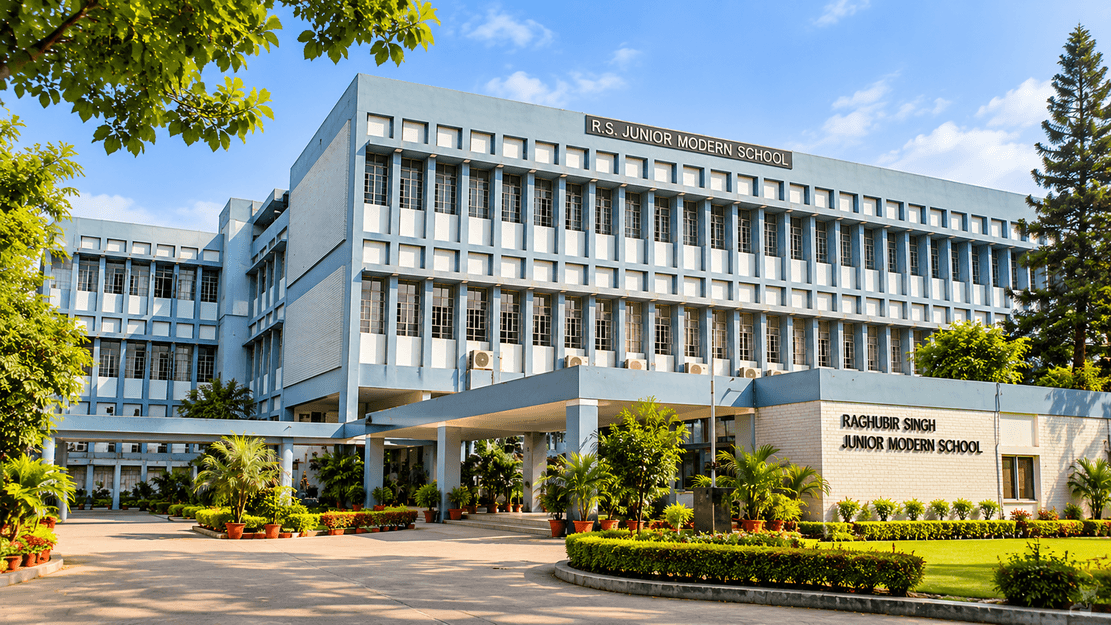
How do we prepare young children for an AI-driven future without losing play and basic human values? This is one of the biggest questions in modern parenting. With worries about screen time on one side and changing workplace demands on the other, parents want a middle ground between digital skills and emotional grounding.
Raghubir Singh Junior Modern School (RSJMS) offers one answer. It was established in 1961 as the primary wing of Modern School, Barakhamba Road, and carries that school's century-old legacy while trying out new ways of teaching. Here are five things that stand out.
1. AI Labs and Minecraft Are Not Just for High Schoolers
Many schools keep computing for older students. RSJMS brings artificial intelligence into the primary years. The campus has a dedicated AI Lab for classes P3 to P5, where trained facilitators help children understand complex technology through hands-on projects.
Working with Microsoft, the school weaves Minecraft Education, logic kits and interactive AI modules into the curriculum. This project-based approach turns abstract maths and logic into something children build. Every classroom from Nursery to Class P5 is also a Smart Board "Digi Class" with subject-specific digital banks and its own air purifier.
"To match the pace of the growing and advancing world, RSJMS now has an AI Lab for the students of P3 to P5. It is a structured learning environment where students explore artificial intelligence, coding, and data-driven problem solving through guided activities, projects, and real classroom applications."
Why it matters: structured logic and computing tools move screen time from passive watching to creative problem-solving. Children learn by building algorithms and working with data. Clean air in the classroom also supports health and focus in a dense city.
2. No Exams in the Early Years
High-stakes testing in early childhood can cause anxiety and push children toward memorising instead of understanding. RSJMS has no formal examinations from Nursery through Class P2. Teachers track progress through continuous observation, assignment checklists and everyday classroom interaction.
The early classrooms are designed to feel lively and playful. Core subjects come alive through storytelling, music, theatre, games and clay modelling, so children learn by discovering rather than being told.
"We believe that early learners thrive in an environment where learning happens naturally – through exploration, meaningful interaction."
Why it matters: without formal grades in these years, children keep their natural motivation and link learning with curiosity instead of test stress. Structured assessments begin from Class P3.
3. Ten-Year-Olds Co-Edit the School Magazine
Student voice at RSJMS goes beyond class monitors. Primary students have a real role in the school's official publications.
The editorial board of the biannual school magazine, Sandesh, has three teacher editors and thirteen Class P5 students. The students help with every stage: collecting articles, proofreading, artwork, page layout and planning. Sandesh is published in October and March, at the Valedictory Ceremony. Alongside it, Three Wise Men is a twice-yearly e-newsletter for pre-primary that records Nursery and KG milestones.
"The editorial board comprises three teachers and thirteen students from P5. Every year, the students work closely with the teacher editors on the entire process of creating the magazine."
Why it matters: real publishing builds editing discipline, critical thinking and teamwork. Students decide on layouts, improve their writing and meet actual deadlines, so literacy becomes a lived skill.
4. Hospital-Grade Medical Care and Learning Support
Children learn best when they feel physically safe and emotionally secure. RSJMS builds both into daily campus life.
- First-Aid Centre: run all day by Apollo Life, with a resident physician and two trained nurses.
- Ambulance: a school ambulance is on standby daily from 7:30 am to 3:30 pm.
- Insurance: all enrolled students are covered under a Group Personal Accident Insurance Policy (GPAIP).
- Learning Centre: a special education centre with trained counsellors and special educators, who adapt teaching for students with learning differences or behavioural challenges.
"The Learning Centre, a centre for special education needs, provides specialized support and a differentiated learning environment for children with learning challenges and cognitive difficulties."
Why it matters: when children feel safe, they are more willing to take intellectual risks. Support for neurodiverse learners means every child gets the accommodations they need.
5. Sports Fields with a Community Twist
At RSJMS, movement is a core part of building character. The school has a three-acre sports field with an eight-lane, 200-metre athletic track made of polyurethane and rubber composite, which is designed to reduce injuries from falls. The school has produced well-known sportspeople, including Indian cricketers Gautam Gambhir and Kirti Azad. It also organises friendly cricket matches for fathers, which brings families onto the field with their children.
"The athletic track is made of polyurethane and rubber composite to ensure that children don't get hurt when they fall, further reinforcing their zeal for athletic activities."
Why it matters: good facilities plus events that involve parents make sport a shared, lifelong habit and strengthen the family's link with the school.
The Bigger Picture
RSJMS shows that a long heritage and modern ideas can work together: early AI exposure, play-based early assessment, real student publishing and strong health infrastructure. Primary education does not have to choose between character building and technology.
As education changes, is it time for primary schools to focus less on test scores and more on wellbeing, creative technology and play?
Facilities and policies can change. Please confirm details with the school before making admission decisions.