
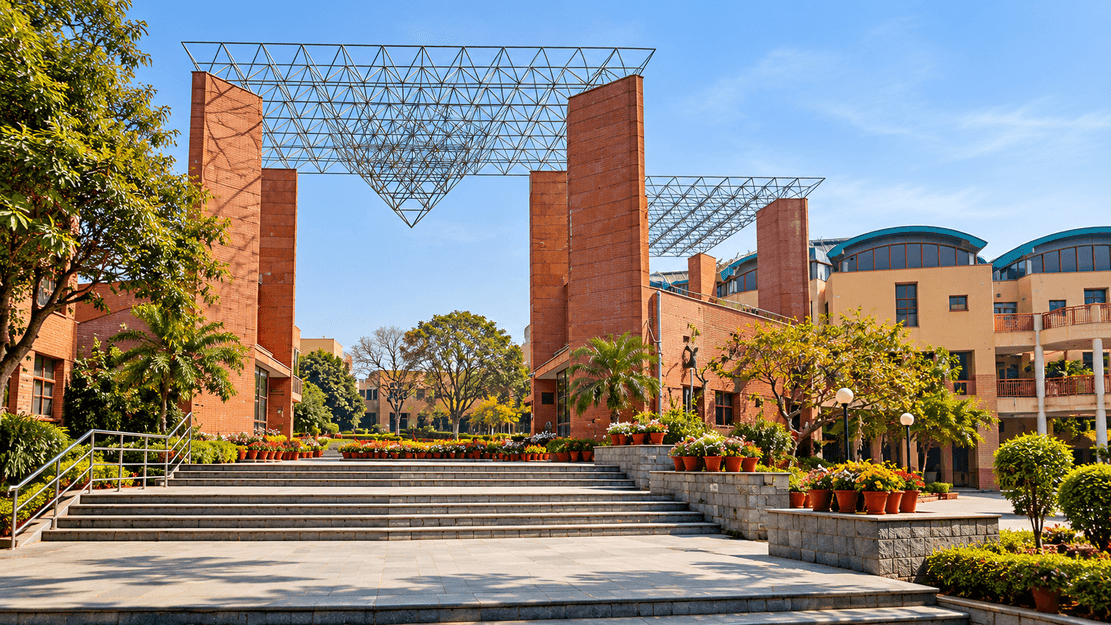
Sanskriti School sits in New Delhi's diplomatic enclave, on Dr. S. Radhakrishnan Marg, Chanakyapuri. It is one of the capital's most sought-after schools. Admission is highly competitive, and it works through a quota system that many parents find confusing. This guide covers the school's background, how it teaches, its campus, its inclusion programmes, admission categories and estimated fees.
A Legacy of Excellence
Sanskriti School was set up by the Civil Services Society, an organisation formed by the wives of civil servants from different branches of the Government of India. Its foundation stone was laid on 30 May 1996 by Smt. Hemi Surendra Singh, then Chairperson of the Society, and it opened to students on 12 August 1998.
The school was founded mainly for the children of All India Services and Allied Services officers, and of Defence personnel, who are often transferred. Today it is open to students from all professional backgrounds.
Motto: "Vidhyaya cha vimuchyate", meaning "Knowledge is liberation".
It is a public sector, non-profit school. The Chairperson of its Managing Committee is the spouse of the serving Cabinet Secretary of India, currently Ms. Hema Somanathan.
Academics and Teaching Approach
The school is affiliated with CBSE and has over 2,500 students. Principal Mrs. Richa Sharma Agnihotri has more than 23 years of experience in international curricula. The school stresses hands-on learning, 21st-century skills and smaller class sizes for individual attention. Learning is organised in four phases:
- Early Child Development (Pre-Primary): child-centred, with sensory development and environmental studies. Children do fireless cooking, music and dance, and take part in events such as "Jashn-e-Khidmat" and "Parents Day Out" in a non-competitive setting.
- Junior School (Classes I-V): activity-based and joyful. There are no formal exams for Classes I to III. Class III has graded periodic assignments, and Classes IV and V have weekly unit tests assessed by grades only.
- Middle School (Classes VI-VIII): builds a secure learning base and supports emotional, physical and social well-being, helping students become empathetic listeners, creative thinkers and effective communicators.
- Senior School (Classes IX-XII): intensive academic preparation with innovative teaching methods. Each morning has an "interactive period" with the class teacher, to keep students sensitive and sensible global citizens.
Campus and Facilities
The amphitheatre
The large amphitheatre in the centre of the school seats around 600 people. Its circular stage holds 50-60 children at once. It is used for assemblies, prize distributions and the Class XII graduation citation ceremonies, and in winter teachers and students use its sunlit steps for outdoor study.
Classrooms and technology
- Large, airy classrooms with plenty of natural light.
- Every classroom has a projector, a laptop and Wi-Fi.
- Personal lockers in every classroom, to lighten school bags.
- Class libraries in junior classrooms, managed by class teachers.
Library
Reading resources are spread over three large central hubs.
| Facility | Details |
|---|---|
| Total area | 8,611.1 sq ft (800 sq m) |
| Junior school reference books | 12,112 titles |
| Middle school reference books | 6,999 titles |
| Senior school reference books | 7,584 titles |
| Periodicals, dailies and magazines | 6 periodicals, 6 dailies, 17 magazines |
Canteen and eco-initiatives
The canteen is in the Art Block and is overseen by a committee of parents and staff. It serves a varied menu from South Indian to Chinese. Single-use plastic is banned, food is served in steel utensils, and biodegradable waste goes into a compost pit behind the building. CCTV monitors kitchen hygiene.
The campus also has a staffed infirmary, science and IT labs, sports facilities and the Art Block.
Inclusion and Special Programmes
The Umang Programme
Umang means "Joy". It is the school's flagship effort to bring students from economically weaker sections (EWS) into a high-quality school, where they take part in every activity alongside their peers. The school has reserved 25% of its seats for EWS students, a practice it has followed since 2004.
The Learning Centre
Since the school opened in 1998, the Learning Centre has supported gifted children and those who need help with specific challenges. It has a Junior section (Nursery-VI) and a Senior section (VII-XII). A team of professionals designs customised plans that cover academics as well as socio-emotional, physio-motor, linguistic and pre-vocational skills.
Student clubs
Student-led clubs include Alpha (Maths), Bizzonomy (Business/Economics), Exposure (Photography), GirlUp Moksh, Interact (Community Service), Neutrino (Physics), ProjectBeta (IT) and Viridian (Environment), among others.
Admission Categories
Because the school was created for officers who are transferred often, admission follows a strict quota system:
- All India Services and Allied Services: for children of central government officers, especially those facing frequent transfers.
- Defence personnel: seats for children of armed forces personnel.
- General category: open to the public and private sector professionals, whatever the parents' profession.
- EWS category: 25% of all seats.
Registration is online through a Common Registration Form on the school's ERP portal for Nursery/Pre-school. There are separate intake periods for Classes II, IV, IX and XI. General category seats are very competitive, since only a limited share remains after the government, defence and EWS quotas are filled. Keep a close eye on the school calendar.
Estimated Fees
Fees depend on the class and have three parts: one-time charges, annual charges and monthly fees. The figures below are estimates based on recent sessions.
- Admission fee (one-time): Rs. 200
- PTA fee (annual): Rs. 500
- Annual charges: about Rs. 22,000 (varies slightly by class)
- Development fee: about Rs. 2,057 (varies by class)
| Class | Estimated monthly fee |
|---|---|
| Nursery - Class 2 | Rs. 19,413 |
| Class 3 - Class 5 | Rs. 19,495 - Rs. 19,496 |
| Class 6 | Rs. 17,282 |
| Class 7 | Rs. 15,047 |
| Class 8 | Rs. 14,410 |
| Class 9 | Rs. 14,385 |
| Class 10 | Rs. 14,373 |
| Class 11 | Rs. 15,226 |
| Class 12 | Rs. 15,260 |
These monthly figures include tuition and apportioned recurring fees but exclude optional transport. They may differ slightly by senior secondary stream or after mid-year revisions, so check the school's official fee structure.
Frequently Asked Questions
Who manages Sanskriti School?
It is a public sector, non-profit school managed by the Civil Services Society. The Chairperson is the spouse of the serving Cabinet Secretary of India.
Can general category students apply?
Yes. The school was set up for children of All India Services, Allied Services and Defence personnel on transfer, but it is now open to all students regardless of parents' profession.
What is the Umang programme?
Umang ("Joy") is the school's social responsibility initiative for children from economically weaker sections. 25% of seats are reserved for them.
Does the school support special needs?
Yes, through the Learning Centre, which has a Junior section (Nursery to Class VI) and a Senior section (Class VII to XII).
What is the canteen like?
It is in the Art Block and serves hygienic food from South Indian to Chinese. It uses only steel utensils, bans single-use plastic and composts biodegradable waste.
Our Verdict
Sanskriti School is a structured, all-round school. It is an excellent fit for government and defence families who move often and want stability. For the general public it offers a well-equipped campus, a diverse peer group through Umang and experienced academic leadership, if you can win a seat in the competitive general quota.
| Strengths | Consider |
|---|---|
|
|
Official Links
- School homepage · School information · Contact · Academic calendar · Parent portal · Managing Committee
- Admissions (2026-27): Common Registration Form · Nursery · Class II & IV · Class IX · Class XI
- Fees: Fee structure 1 · Fee structure 2 · Detailed fee PDF
- Curriculum: Early Child Development · Junior School · Middle School · Senior School · Learning Centre · Umang
- Campus: Transport · Library · Labs · Canteen · Infirmary · Amphitheatre
- Certificates and disclosures: CBSE affiliation (valid till March 2028) · Fire safety · Structural stability · Mandatory public disclosure
Admission rules, dates and fees change every year. Please confirm them on the school's official website before applying.