
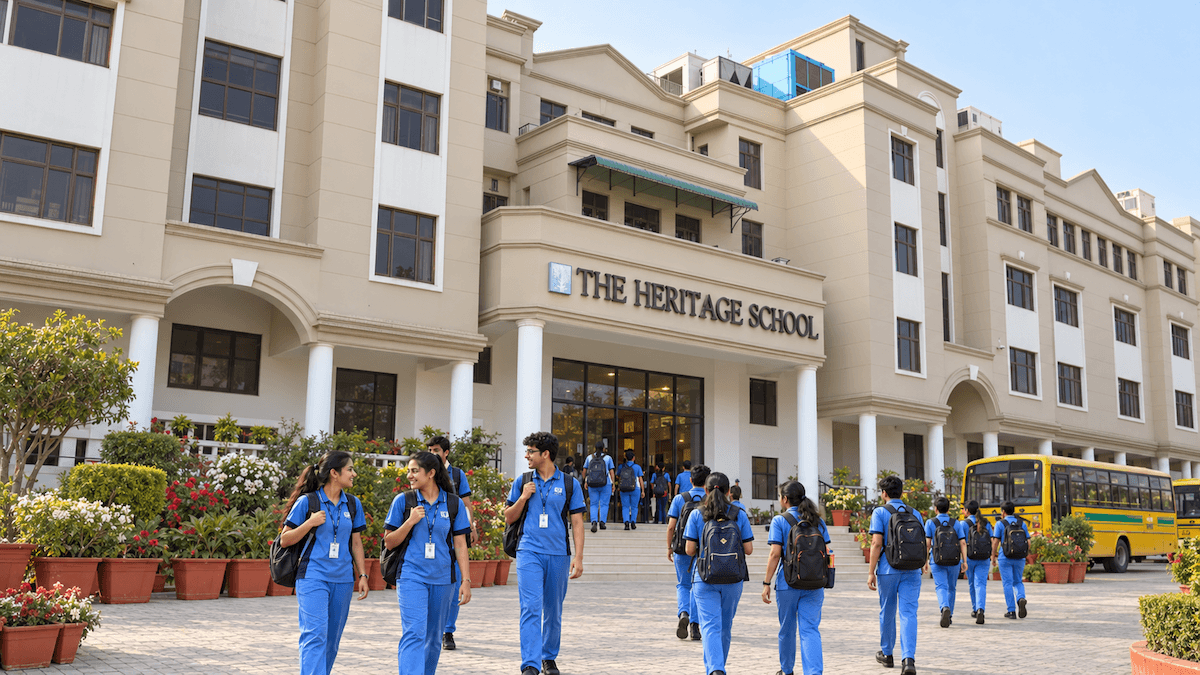
Looking for a clear guide to The Heritage School, Rohini? Parents in North-West Delhi often ask two questions: what kind of school is it, and how does nursery admission actually work? This guide answers both. It covers the school's experiential approach to learning, its campus and programmes, and the full 100-point admission criteria, seat distribution, age rules, documents and application process for the 2026-27 session.
This guide records the 2026-27 process. Criteria, seat numbers and dates change every session, so please confirm the current details on the school's official website before applying.
The Heritage School, Rohini at a Glance
| Detail | Information |
|---|---|
| Address | Plot No. 8, Sector 23, Rohini, New Delhi - 110085 |
| Established | 2002 |
| Campus area | 16,188 sq. m (about 4 acres) |
| Board | CBSE, co-educational |
| Principal | Ms. Yakshi Gulati |
| Approach | Experiential learning and holistic child development |
| Website | rohini.ths.ac.in |
| Phone | 011-27062800, 011-27062900, 9773983614, 9773983615 |
| admission@rohini.theheritageschool.in, contact@rohini.theheritageschool.in |
Nursery Admission at a Glance (2026-27)
| Feature | School Specification |
|---|---|
| Neighbourhood distance | 80 points (0 to 8 km), 70 points (above 8 km) |
| Sibling | 15 points |
| Alumni | 5 points |
| Total seats | 144 |
| Open / General seats | 101 (70%) |
| Twin clause | Admission of the second twin is automatic if the first is selected |
| Registration fee | ₹25, non-refundable, paid online |
| Interview | None |
| Hard copies at registration | Not required |
About The Heritage School, Rohini
The Heritage School, Rohini was established in 2002 and sits on a campus of about four acres in Sector 23. It is a co-educational CBSE school that describes its approach as experiential learning: children learn by doing, questioning and reflecting, not only by memorising chapters. The school treats childhood as an active journey of self-discovery, not just preparation for adult life, and keeps the child at the centre of both teaching and daily routines.
The Philosophy: Three Living Ideals
The school's thinking rests on three ideals that it tries to turn into everyday classroom practice:
- Manthan: introspection and reflective inquiry. Students, teachers and school leaders are encouraged to keep asking why they learn what they learn.
- Samstha: the school as a living community. Students, teachers, parents and staff help build its culture and values.
- Prakriya: the process, meaning the methods and routines that turn the school's vision into real classroom experiences.
The Six Dharmic Principles
Conduct and governance at the school are guided by six principles: attentiveness, authenticity, freedom to be, learn and grow, inclusion, respect and excellence. Parents choosing a nursery school can use these as a quick way to understand what the school values in children from the earliest years.
How Learning Works at The Heritage School
The school draws on progressive educators such as Mahatma Gandhi, J. Krishnamurti, John Dewey and Sri Aurobindo, and aligns its curriculum with NEP 2020 and NCERT frameworks. It prefers discovery and real-world application to rote learning.
Three Reflective Questions
Students regularly ask themselves three questions: Where am I right now? Where do I want to be? What steps will bridge the gap? The aim is intrinsic motivation and self-directed learning instead of reward-and-punishment systems.
Teachers as Facilitators
Teachers act as facilitators who learn alongside students. To support this, the school says its educators take part in about 300 hours of professional development each year, including whole-school retreats and action research.
Learning Stages: From Pre-School to Grade XII
Junior Programme (Pre-School to Grade III)
For families applying to nursery, this is the stage that matters most. Early learning focuses on wonder, sensory exploration and foundational literacy.
- Global Systems Science: an interdisciplinary science curriculum that links natural phenomena, ecological balance and human responsibility.
- Junior Makers Programme (Grades I to III): hands-on tinkering that introduces science, technology, engineering and design thinking.
- Theatre and Satvikam practice (Grade III): children write and perform original productions, using a centring technique that builds emotional awareness and empathy.
Middle Programme (Grades IV to VIII)
- Conceptual mathematics with Jodo Gyan: maths is taught through manipulatives and visual reasoning. Students even walk a full kilometre to feel what the unit means.
- Field expeditions: visits to places such as the Pradhanmantri Sangrahalaya, TERI Gram, Chandni Chowk and Mother Dairy anchor classroom ideas in the real world.
- Assessment as learning: students build growth portfolios and present them in student-led family conferences, shifting the focus from performance to purpose.
Senior Programme (Grades IX to XII)
The senior years combine board and olympiad preparation with global exposure, including a French exchange programme in Paris and the World Scholar's Cup, along with career and college counselling.
Community, Clubs and Co-Curriculars
- Social Action Projects: a four-stage cycle of plan, explore, create and reflect. Grade V students, for example, work with the environmental organisation Swechha to plant and maintain campus herb gardens.
- CARE initiatives: senior students run projects linked to the UN Sustainable Development Goals, making and selling upcycled goods and reinvesting the proceeds in community work.
- Clubs and societies: middle school clubs include Anveshan, Anusandhan, Books and Beyond, Voices and Vision and Build X. Senior societies include a debating society, an eco club, Commerce Verse and the PsyCare Club.
- Student committees: students sit on anti-bullying, cyber safety, disaster management, food health and road safety committees.
- Physical literacy: sport follows a framework covering the physical, cognitive, social and emotional sides of movement, with events such as Prayaas (junior), Athlitika Agon (middle) and Athlosyn (senior).
Well-Being and Inclusive Education
- Quality Circle Time: morning circles with breathing exercises and emotional check-ins build peer bonding and self-awareness.
- Silence Time: the day ends with a short period of quiet reflection.
- Life skills: the EQUBE curriculum develops emotional intelligence and moral reasoning, and annual digital wellness workshops cover digital hygiene, diet, dementia and quotient.
- Special education needs: when learning differences are identified, clinical psychologists carry out assessments and special educators prepare Individualised Educational Programmes.
Nursery Admission Criteria: The 100-Point System
For Open Category seats, candidates are scored on a 100-point matrix that follows Directorate of Education (DoE) guidelines.
| Parameter | Criteria | Points |
|---|---|---|
| Neighbourhood distance | 0 to 8 km | 80 |
| Above 8 km | 70 | |
| Sibling | Real biological brother or sister currently studying in the school | 15 |
| Alumni | Father or mother is an alumnus or alumna of the school | 5 |
| Total | 100 |
Distance is calculated using Google Maps, as specified on the school's portal.
Distance (80 or 70 Points)
Distance carries most of the score. Families within 8 km receive 80 points and those above 8 km receive 70, so the gap between the two slabs is only 10 points.
Sibling (15 Points)
Sibling points apply only to a real biological brother or sister who is currently studying at the school.
Alumni (5 Points)
Alumni points apply if the father or mother is an alumnus or alumna of the school. This is the smallest component, but it can still separate close scores.
Every Possible Score
Because the school has only three components, there are just seven possible total scores. These are worked out from the points above.
| Total Score | Distance | Sibling | Alumni |
|---|---|---|---|
| 100 | 80 | 15 | 5 |
| 95 | 80 | 15 | 0 |
| 90 | 70 | 15 | 5 |
| 85 | 80 | 0 | 5 |
| 85 | 70 | 15 | 0 |
| 80 | 80 | 0 | 0 |
| 75 | 70 | 0 | 5 |
| 70 | 70 | 0 | 0 |
The possible totals are 100, 95, 90, 85, 80, 75 and 70. The score 85 can be reached in two ways.
What the Numbers Mean for Your Child
- A sibling beats a closer address. A child living above 8 km with a sibling in school scores 85, which is higher than a child within 8 km with no sibling (80).
- Alumni points are smaller than the distance gap. A child within 8 km without alumni points (80) still scores higher than a child above 8 km with an alumni parent (75).
- Most families score 80 or 70. Many applicants have no sibling or alumni link, so their position depends on distance alone.
- Ties are decided by draw of lots. When applicants have the same score, the school settles it through a transparent draw.
There are no first-born or girl child points at this school. For schools that do give them, see our guide to first-born points and affidavit rules.
Seat Distribution (144 Seats)
| Category | Share | Seats |
|---|---|---|
| Open / General | 70% | 101 |
| EWS / Disadvantaged Group | 25% | 36 |
| Staff quota | 5% | 7 |
| Total | 100% | 144 |
The 100-point system above applies to the 101 Open / General seats. The school does not list a management quota in this breakdown.
Age Eligibility and Age Relaxation
- Nursery (Pre-School): the child must be 3+ years and less than 4 years as on March 31. For the 2026-27 session, that means a birth date between April 1, 2022 and March 31, 2023.
- Age relaxation: parents can apply in writing to the Principal for relaxation of up to 30 days on the minimum or maximum limit, as per DoE guidelines.
If your child was born just outside the window, read our guide on age relaxation for Delhi nursery admission before you write to the school.
Key Admission Policies Parents Should Know
1. Automatic Twin Protection
If twins apply and one child is selected through the point list or the draw of lots, the second twin automatically receives admission. Your children cannot be separated by the draw.
2. No Hard Copies at Registration
You do not need to submit printouts of the form or physical documents at the school counter during registration. Signed forms and supporting certificates are submitted only at verification, if your child is shortlisted.
3. No Interview
The school does not interview children or parents. After the final admission list is published, it holds an orientation session for the parents of selected children.
4. Online Registration Fee
The registration fee is ₹25, non-refundable, and is paid online while submitting the form.
How to Apply: Step by Step
- Check your distance to the school using Google Maps and note whether you fall within 8 km.
- Confirm the age window for your child's date of birth.
- Register online on the school's portal and pay the ₹25 fee.
- Upload address proof. The school asks you to upload any two valid address proofs in a parent's name, such as Aadhaar, Passport, Voter ID, Driving License, a utility bill or a lease deed.
- Wait for the list. Selection is by points, and tied scores go to a draw of lots.
- Attend verification with originals and self-attested photocopies, along with the signed application form, if your child is shortlisted.
- Attend the orientation session if your child is selected.
Documents Required at Verification
Shortlisted parents must bring original certificates and self-attested photocopies:
- Child's date of birth certificate issued by the Municipal Corporation or local authority.
- Proof of residence (any one): Aadhaar or UID card of the parents, Voter ID (EPIC) of either parent, a Passport in the name of a parent or the child, a recent electricity, MTNL telephone, water or gas bill, or a Domicile Certificate of the child or parents.
- Sibling proof, if applicable: a fee receipt or student ID card of the real biological sibling currently on the school roll.
- Alumni proof, if applicable: the passing certificate or CBSE Board certificate of the alumnus parent.
Keep the address on your documents the same as the address on the form. For more on address proof rules across Delhi schools, see the points system guide below.
Common Mistakes to Avoid
- Measuring distance by guesswork. The school uses Google Maps, so check your address on the map.
- Assuming a sibling at another branch counts. Only a sibling currently studying in this school qualifies.
- Claiming alumni points without a certificate. Keep the parent's passing or CBSE Board certificate ready.
- Address mismatch between the form and the proof you upload.
- Applying twice for twins. Check the notice for how twin applications should be filed.
- Waiting until the last day to collect documents.
Frequently Asked Questions
What is the admission criteria for The Heritage School, Rohini nursery?
A 100-point system: 80 points for distance within 8 km (70 above 8 km), 15 points for a sibling and 5 points for alumni.
How many nursery seats are there at The Heritage School, Rohini?
There are 144 entry-level seats: 101 Open / General, 36 EWS / Disadvantaged Group and 7 Staff quota.
What is the age limit for nursery admission?
The child must be 3+ and below 4 years as on March 31. For 2026-27, that means born between April 1, 2022 and March 31, 2023.
Is age relaxation available?
Yes. Parents can apply in writing to the Principal for relaxation of up to 30 days, as per DoE guidelines.
What happens if twins apply?
If one twin is selected through the point list or the draw of lots, the second twin automatically receives admission.
Do I have to submit documents at the school during registration?
No. Hard copies of the form and documents are needed only at verification, if your child is shortlisted.
Does the school hold interviews?
No. There are no interviews or interactions with children or parents. An orientation session is held for the parents of selected children.
What is the registration fee?
₹25, non-refundable, payable online while submitting the form.
How are tied scores handled?
Through a transparent draw of lots.
Which sibling qualifies for the 15 points?
A real biological brother or sister who is currently studying in the school.
Who earns alumni points?
A child whose father or mother is an alumnus or alumna of the school earns 5 points.
Which documents prove address?
Aadhaar or UID, Voter ID, Passport, a recent utility bill or a Domicile Certificate, among others, as listed above.
Related Reading
- Delhi nursery admission points system explained, with worked examples
- Bal Bharati Public School, Pitampura: complete school overview and admission guide
- First-born points: affidavit and stamp paper rules
- Alumni points: proof, membership and duration rules
- Schools with no bus transport for Nursery
- Age relaxation for Delhi nursery admission 2027-28
Our Verdict
| Area | Summary |
|---|---|
| Learning approach | Experiential and reflective, with a strong emphasis on values and well-being. |
| Admission system | Simple 100-point scoring that depends mostly on distance, with sibling and alumni points. |
| Parent-friendly policies | Twin protection, no interview and no hard copies at registration. |
| Seats | 101 Open / General seats out of 144. |
The Heritage School, Rohini suits parents who want a school that values curiosity, reflection and community alongside academics. Its admission process is easy to understand: measure your distance, check the age window, register online and keep your documents ready for verification. Most applicants will land on 80 or 70 points, so a sibling or alumni link can make a real difference.
Admission rules, seats, fees and dates change every year. Please confirm them on the school's official notice before applying.